

Tyrone’s rich engineering heritage celebrated at Ferguson patent centenary lecture
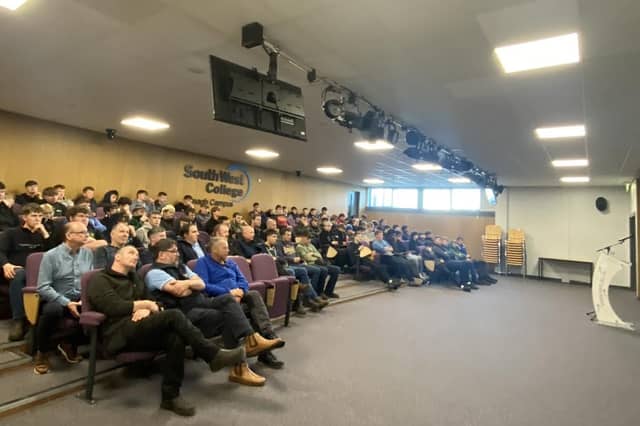

Historian highlights the county’s world-changing innovators and the importance of inspiring the next generation
THE remarkable contribution of County Tyrone to engineering and innovation was celebrated at South West College in Omagh as local historian and author Stevan Patterson delivered a special lecture marking 100 years since the granting of the Ferguson Master patent.
Held on Tuesday, October 13, the lecture explored how Harry Ferguson’s revolutionary vision transformed agricultural machinery and helped shape the modern tractor, while highlighting the important role played by Tyrone people and places in bringing his ideas to life.
The Ferguson Master patent, officially numbered 253,566 and titled Apparatus for Coupling Agricultural Implements to Tractors and Automatically Regulating the Depth of Work, was filed by Ferguson on February 12, 1925, and granted on June 14, 1926.
His pioneering concept enabled a tractor and a range of quickly interchangeable implements to operate together as a single unit, an innovation now recognised as a defining moment in the development of the modern tractor.
A century on, the patent remains a landmark achievement in agricultural engineering, with the lecture providing an opportunity to reflect on its enduring impact and the ingenuity behind its creation.
Harry Ferguson (1884–1960), widely regarded as the father of the modern tractor, was born in County Down but perfected his ground breaking Ferguson System in County Tyrone.
A key figure in that story was Thomas MacGregor Greer of Tullylagan Manor, outside Cookstown, who provided the main financial backing for the development of the system. It was on his estate that the Ferguson System was perfected by autumn 1935.
Greer’s contribution was substantial, having invested most of the £156,350 required to develop the system. He also owned the rights to the Ferguson brand name.
The world’s first production Ferguson System tractor, the Ferguson-Brown Type A, serial number one, went to Greer. He also received the first Ford-Ferguson tractor to arrive in Northern Ireland in 1939, following the agreement between Ferguson and Henry Ford.
The lecture highlighted several other important milestones in the Ferguson story, with 2026 also marking 95 years since the three-point hydraulic linkage reached its final form, incorporating two lower links and a single upper link.
This year also marks 90 years since the Ferguson-Brown Type A became the world’s first production Ferguson System tractor, 80 years since the first Ferguson TE20 appeared in 1946, and 70 years since the Ferguson FE-35 was introduced in 1956.
Beyond the machinery itself, Mr Patterson drew attention to the importance of education in nurturing innovation.
Ferguson left school at the age of 14 before moving to Belfast, where his only further formal education came through evening classes at the city’s technical college. Alongside this learning, he designed and built his first aeroplane, which took to the skies on December 31, 1909, achieving the first heavier-than-air flight in Ireland.
His story provided a powerful example of how practical experience, technical education and determination can combine to produce world-changing achievements.
Mr Patterson also highlighted the achievements of another Tyrone-born innovator, John Finlay (1929–1986), regarded as the father of mobile crushing and screening equipment.
Finlay opened his first purpose-built factory for manufacturing screening equipment in Omagh in 1976, making 2026 the 50th anniversary of that milestone.
His inventions revolutionised the quarrying and screening industries worldwide, while the engineering legacy he established continues to support businesses, employment and wealth creation across County Tyrone.
Another figure whose achievements featured in the lecture was Frank Crossley (1839–1897), whose work helped transform industrial engineering during the 19th century.
Educated in Tyrone and having served in the Army at Omagh, Crossley worked closely with German engineer Nikolaus Otto to perfect the four-stroke internal combustion engine in 1876.
Together with his brother William Crossley, he subsequently mass-produced engines at the Crossley Brothers factory in Manchester, helping establish the technology on a global scale.
The achievement played a significant role in the development of the Second Industrial Revolution, underlining the international impact of innovation connected to Tyrone.
Mr Patterson, who is also a member of the St Lucia Barracks regeneration committee and serves as its liaison officer, used the lecture to highlight the potential for Omagh to celebrate this remarkable heritage through the preservation and development of the historic barracks site.
He believes St Lucia Barracks could become a national centre celebrating the county’s military history, heritage and achievements, with three complementary museums: a military museum reflecting the history of the site, a County Tyrone museum and a Museum of Innovation and Achievement dedicated to the people whose ideas changed the world.
His vision also includes a world-class research and innovation centre linking local schools, South West College, universities and businesses.
Such a development, he believes, could encourage tourism and investment while providing an inspiring environment in which young people can discover the achievements of the past and develop their own ambitions for the future.
The centenary lecture concluded on an uplifting note, with Mr Patterson highlighting the many other innovators and achievers associated with County Tyrone and the importance of ensuring their stories are remembered.
As students listened in the South West College lecture theatre, the message was clear: the county’s history is rich with people who dared to think differently, solve problems and turn ideas into reality.
And, as the presentation looked back on the achievements of Harry Ferguson and other pioneering figures, it left open an exciting possibility - that the next great innovator could already be sitting in a classroom in Tyrone, preparing to make their own mark on the world.