

Strabane stroke survivor supports charity to highlight ‘Survival Is Not Enough’

A stroke survivor from Strabane is sharing his story on World Stroke Day, as part of a national campaign to spotlight the fragility of the brain and the life-changing impact a stroke can have on people of all ages.
A stroke survivor from Strabane is sharing his story on World Stroke Day, as part of a national campaign to spotlight the fragility of the brain and the life-changing impact a stroke can have on people of all ages.
Jim Hunter, 70, had a stroke three years ago just hours after completing a 20-mile cycle on a gym bike. He is raising awareness of stroke as part of the Stroke Association’s ‘Survival Is Not Enough’ campaign.
In March 2023, Jim went to bed but woke in the early hours of the following morning with what he described as a “blinding headache” and feeling unwell. After taking painkillers, he returned to sleep, but his condition deteriorated the following day.
Jim said: “At around 4pm, I tried to get out of bed but suddenly collapsed onto the floor. I immediately knew I was having a stroke.”
Jim was traumatised from his time in hospital and didn't get the right amount of physiotherapy he needed. Beyond the physical consequences of the stroke, the emotional and psychological toll has been profound.
He said: “When I left the hospital and had visitors, they would say you look fantastic but inside you are just dead.”
The most frustrating aspect of Jim's new reality is his inability to do tasks such as servicing his daughters’ cars anymore. While jobs he once handled with ease, like fixing a broken roof tile, have to be outsourced.
He said: “I have chronic fatigue so I sleep a lot and it can be soul destroying.”
Jim has struggled with his mental health since his stroke. He said: “I never roared or shouted before, but I changed, I lost my temper more and didn’t even realise it. I couldn’t understand why I was reacting like I was.”
He believes emotional and mental health support should be provided alongside physiotherapy. He said: “Psychologically, more needs to be done for stroke survivors as it is the biggest part of your recovery.”
In the UK, someone has a stroke every five minutes, with 1.4 million people currently living with a brain injury caused by stroke. More than 85,000 people survive a stroke every year, but recovery is only the beginning. Many face a long and gruelling journey adjusting to the trauma and rebuilding their lives, often left without the essential long-term rehabilitation and support they need. Despite the life-changing impact of stroke, awareness of its severity and the long-term challenges survivors face remains worryingly low amongst the general public.
Despite one in four strokes happening to people of working age, a third of Brits aged 18-34 (34%) and almost a quarter of 35-44 year olds (24%) believe they’re too young to have one.
The knowledge gap extends to the impact of stroke, with almost a third (32%) unaware that it is a brain injury and nearly one in five (19%) not realising it can cause long-term difficulties with walking, talking, seeing or swallowing. Almost a quarter (22%) underestimate the road to recovery believing it takes just a few months or less.
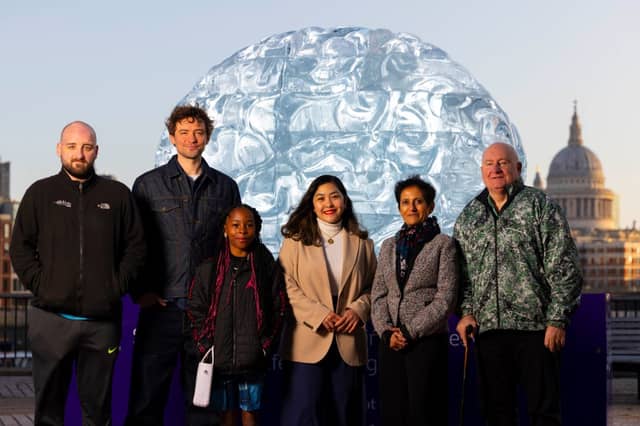
As part of the campaign, the Stroke Association unveiled a giant brain carved entirely from ice on London’s Southbank this week, creating a striking spectacle in the heart of the capital. Standing at 2.5 metres tall, the sculpture, which took 150 hours across five days to create, was designed to represent both the complexity and fragility of the human brain.
Jim alongside four other hero stroke survivors helped to inspire the shape of the ice installation with their own brain scans. From Tayshelice, who survived a stroke aged just eight to Jim, now in his 70s, the group also included Jordan, Jermaine, and Rutuja. Together they highlighted how stroke can strike anyone, at any age.
Awareness
The Stroke Association’s campaign ‘Survival is Not Enough’ aims to drive awareness of the impact of stroke and support a two-part documentary series commissioned by Channel 4, in partnership with the charity: ‘Trauma: My Broken Brain’. The series follows three young adults, Dan, Saskia and Dec, through the fight of their lives after a life-threatening stroke. ‘Trauma: My Broken Brain’ is available to stream on Channel 4.
Alasdair O’Hara, Northern Ireland director at the Stroke Association, said: “A stroke is a devastating brain injury, leaving behind life-changing trauma. In an instant, a stroke can steal away the things that many of us take for granted, such as walking, talking, eating and living independently; the things that make you, you. This new research shows that people still don’t understand a stroke happens in the brain and wrongly believe a stroke only affects older people.
“A stroke isn't only a medical emergency from which you either die or survive, but instead the start of a long and gruelling journey to rebuilding a life. For so many stroke survivors, the fight doesn’t end when their lives are saved, yet every day survivors and their families are left traumatised and without the long-term rehabilitation and support they need. After everything a stroke takes, no-one should have to fight for essential support to recover and live a full life again.”
1.4 million people are living with a brain injury caused by stroke. Help the Stroke Association change what comes next: www.stroke.org.uk/brain