

Former Dromore Journalist savoured the magic of Barack Obama's return to Belfast
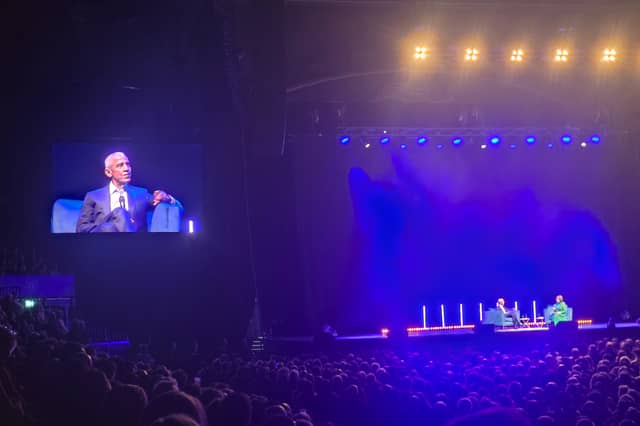

Obama in Belfast: Hope, the Good Friday Agreement and Gaza Peace
RETURNING to Northern Ireland after a 13 year hiatus, Barack Obama urged a sold-out Belfast audience to “insist that we can do better than we’re doing right now.” And he held up the Good Friday Agreement as proof that even bitter divisions can be overcome.
For this was a much-needed (almost) intervention by the two-term captivating President, in keeping with former White House supremos who have offered hope and inspiration to an often beleagured political and peace process here. In this, my third time attending Barack Obama events - in Belfast in 2013 and the White House in 2015, the timing was ideal.
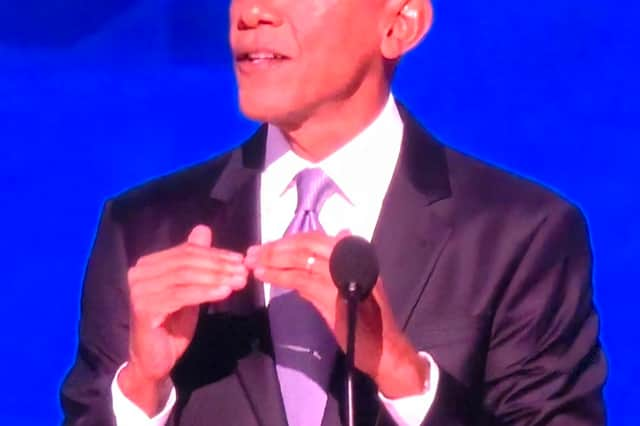
For amid ongoing recriminations and dismay following turbulent regional events including the Drumcree marching crisis and Stormont stalemate, the 44th US President brought star-struck status briefly back to political leadership in the capital city. The capacity crowd were hanging on his every word in the hope of renewed wisdom from an Oval Office holder. It's been a magic formula that has secured political stability here before and since 1998.
Up to 10,000 people filled the O2 Arena beside the Titanic museum for a stage talk with writer Susan McKay, the first stop of Barack Obama's recent three-city tour also visiting Glasgow and Manchester. Earlier in the day he accepted an honorary doctorate at Queen’s University Belfast, matching his Democratic Party partner and his former Secretary of State Hillary Clinton in their QUB alliance.
At Queen’s, Obama praised Northern Ireland’s journey and challenged the next generation to keep building a peaceful, inclusive future. The Good Friday Agreement he said, remains a “shining example” of what happens when people put aside old wounds and choose peace. He then added a warning, read by some as a veiled reference to the current US administration, that peace and democracy even state-side is not inevitable. They “have to be chosen, again and again” and urged the Queen’s graduates to “keep showing the way."
At the O2 Arena, when asked what hope meant to him, Barack Obama returned to the 1998 Agreement. It came about, he said, not only because people were weary of violence but because “somebody started imagining something better,” and saw themselves and each other differently. Hope, he added, is “a practice,” and not a mood.
Prompted by McKay’s reading of the closing lines of Belfast writer Michael Longley’s poem 'Ceasefire', Obama turned to the Middle East, where he was “not as hopeful as I want to be in the short term.”
He drew a direct comparison with Northern Ireland, where three decades of sectarian violence have cost us over 3,700 lives. Gaza, he said, reflects a “tribal, elemental, unforgiving divide” of the kind “we saw here in Northern Ireland,” and “a sort of madness once it breaks out.” Grievance feeds on itself until each side cannot see the other. Yet the Belfast Agreement, in his perspective, showed that such divisions can be bridged. He said Israelis and Palestinians “aren’t going anywhere,” and that progress would need a US government willing to do “creative work.”
Obama said that when citizens abdicate their role, then “somebody fills the void.” He backed institutions such as the United Nations and the Eurpoean Union but said they must “deliver the goods.” He blamed social media for much of today’s polarisation and called for stronger local and long-form journalism. The former president ended the night by embracing the epitaph of rural Northern Irish poet Seamus Heaney by urging: “Yes, let’s walk on air.”