

SEFF calls for Irish Government inquiry into Omagh bombing
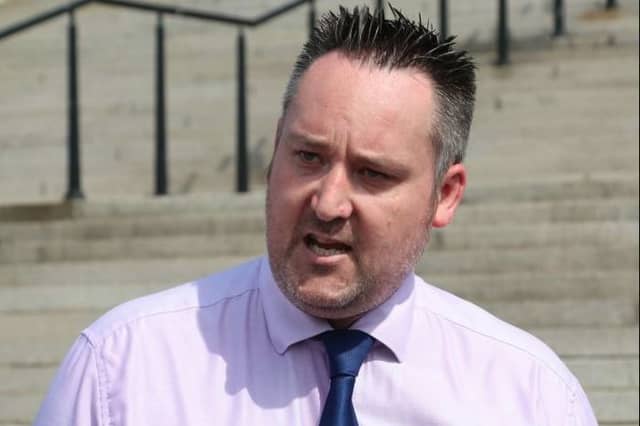

The chief executive of South East Fermanagh Foundation (SEFF), Kenny Donaldson, has called for a fundamental rethink of the approach to the Omagh Bombing Inquiry
The chief executive of South East Fermanagh Foundation (SEFF), Kenny Donaldson, has called for a fundamental rethink of the approach to the Omagh Bombing Inquiry, insisting that the Irish Government must be held accountable for its role in the Troubles and should now establish its own inquiry into the 1998 atrocity.
Mr Donaldson said the failure to secure an integrated, cross-border investigation from the outset had been a "gross miscalculation," warning that the current inquiry could never examine the full circumstances surrounding the bombing.
His comments follow remarks by the Secretary of State on Thursday that it would be "almost inconceivable that the Irish Government would not hold its own Inquiry" into the Omagh bombing.
Welcoming the statement, the SEFF chief executive said it must now be backed up by political pressure to ensure the Irish Government takes the necessary action.
"Before the Omagh Inquiry ever got off the ground we were clear that either a separate Inquiry was required or an integrated cross-border inquiry," he said.
"There were those who pushed on with what we have believing they knew better; that has been proven to have been a gross miscalculation.
"The UK Government should never have progressed an inquiry unless an environment of parity was locked in with the Republic of Ireland. We warned that the TOR of the UK Inquiry would not be able to cover the totality of the Omagh story."
Mr Donaldson was also strongly critical of the Irish Government's approach to the process, arguing that its role had not been adequately scrutinised.
"The Irish Government has been allowed to dance its' way through this process to date and it's just not good enough. It does not augur well for any new Legacy Commission," he said.
"Unless there is a fundamental rethink and a change in attitude from by the Irish State where they accept their 'contributor' role in respect of 'The Northern Ireland Troubles,' thousands upon thousands of victims and survivors will remain failed."
He said the Secretary of State's comments represented an important opportunity to address the imbalance.
"We welcome the Secretary of State's remarks on Thursday that it would be 'almost inconceivable that the Irish Government would not hold its own Inquiry' into the bombing.
"These remarks must now be followed by a willingness to use all necessary political pressure to bring the Irish Government to the place it ought to be moving towards willingly."
Mr Donaldson also took aim at the position of First Minister Michelle O'Neill and Sinn Féin on the justification of violence during the Troubles, arguing that there was an inconsistency in their approach.
"The First Minister is claiming that she and Sinn Fein believe there 'was an alternative' to the bombing of Omagh and its' people but not for every other bomb detonated and trigger pulled which resulted in the murder and maiming of innocents pre the Belfast Agreement," he said.
"This warped mindset needs challenged."
He stressed that the bombing of Omagh, which killed 29 people, including a woman pregnant with twins, was no more justifiable than any other act of violence carried out during the conflict, regardless of who was responsible.
"Omagh was wrong and every other act of terror perpetrated by republicans and loyalists was equally wrong and indeed those occasions where members of the State acted criminally - all acts of premeditated violence were unjustified and unjustifiable."
Turning to the revelations made by retired senior police officer Norman Baxter in evidence to the Omagh Bombing Inquiry, Mr Donaldson said particular attention should be paid to the connections between those involved in the Omagh attack and the Provisional IRA.
He argued that the personnel and weapons used by the terrorist cell responsible for the bombing were closely connected to the organisation.
"Let's explore what Norman Baxter said more closely, the terror cell who carried out Omagh and many other bombings had been Provisional IRA personnel and they had used weaponry which was within the possession of that organisation, there was significant overlap of personnel and armaments."
Mr Donaldson also criticised the British Government's handling of the peace process, claiming that concessions were repeatedly made to republican leaders while the Provisional IRA delayed decommissioning.
He said the organisation had reneged on its commitments to decommission weapons for several years in order to maintain leverage over the political process.
"The facts of history can't be disputed, the Provisional IRA reneged on decommissioning for several years for the purpose of maximising its' abilities in extrapolating concession after concession from a weak and morally corrupt UK Government (with a nod and a wink from its' bedfellows - The Irish Government)," he said.
"Downing Street was a revolving door for The Provisional Republican Movement and the UK Government bought into the ballot and bullet proposition, repeatedly caving in to claims from Irish Republican leaders that more was needed if they were to hold together their constituencies."
Concluding his statement, Mr Donaldson said the evidence presented by Mr Baxter should prompt others to speak openly about the events surrounding the Omagh bombing and the wider Troubles.
"Norman Baxter was speaking the truth, and others need belatedly to do likewise," he concluded.