

Integrated pest management assesses BYDV risk in autumn sown cereals
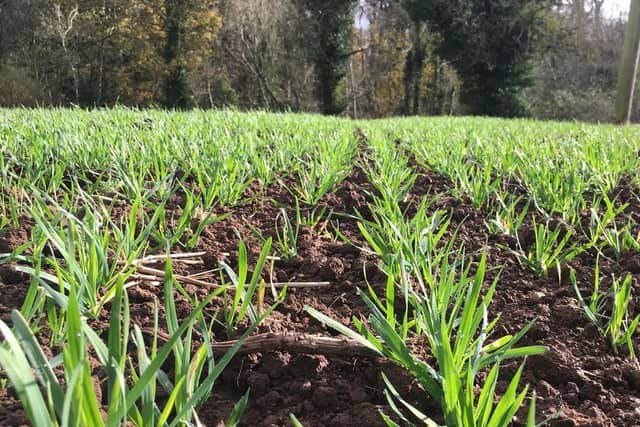

Winter cereal growing progress for farmers
RECENT spells of good weather have provided an opportunity for winter cereal sowing to progress rapidly on farms across Northern Ireland.
“With sufficient moisture to germinate seed and mild temperatures, cereals can emerge in as little as 7-10 days after sowing,” remarks Leigh McClean, Crops Adviser at the College of Agriculture, Food and Rural Enterprise (CAFRE).Whilst early sowing and settled weather improve the chance of successful crop establishment, they also bring the risk of Barley Yellow Dwarf Virus (BYDV) affecting cereal crops.
BYDV is a virus affecting cereals which has the potential to significantly reduce yield. It is spread by migrating, virus infected aphids feeding on newly emerged seedlings.
Aphids can be non-winged and move in from old crop residues and field margins or can be winged and therefore have the potential to travel from greater distances.
Integrated pest management
To monitor winged Aphid numbers, the Agri-Food and Biosciences Institute (AFBI) collect samples using a suction trap on a weekly basis and publish results at: https://eservices.afbini.gov.uk/aphidmonitoring/cereal-aphid.html
“Aphid monitoring gives growers an indication of aphid numbers comparable to previous weeks and how the current season compares to the previous year and long-term average. Farmers can use this information along with their farm situation to assess the risk to their own crops,” comments Daniel Leybourne, Principal Scientific Officer, AFBI.
Milder locations particularly to the south and east, as well as sheltered fields at lower altitudes or proximity to the coast, along with early sowing can all increase the chance of BYDV infections.
AHDB’s newly launched BYDV tool allows growers to input their field location and estimates BYDV risk based on planned sowing date. Alternatively, the tool can be used following sowing by entering field location and crop emergence date, it will then summarise the risk and indicate when to act.
Piecing together all the information and walking emerged crops to scout for aphids will help decide if it’s necessary to act. Where aphids are present and the risk of BYDV infection is high, a single pyrethroid application at the 2-3 leaf stage is effective in controlling aphids and reducing the level of BYDV infection for October sown cereals.
For higher-risk September sown cereals, a second spray may be justified to protect yield if mild settled conditions continue late into the autumn. Multiple pyrethroid applications should be avoided as they accelerate pyrethroid resistance in the aphid population making BYDV control more difficult in future seasons.
Take some reassurance that if conditions are too wet, cold or windy to spray following sowing, they are also poor conditions for aphid migration therefore the BYDV risk will be lower.