

‘Without the young people, this will fade away’ - heartfelt plea to keep the memory of the fallen alive
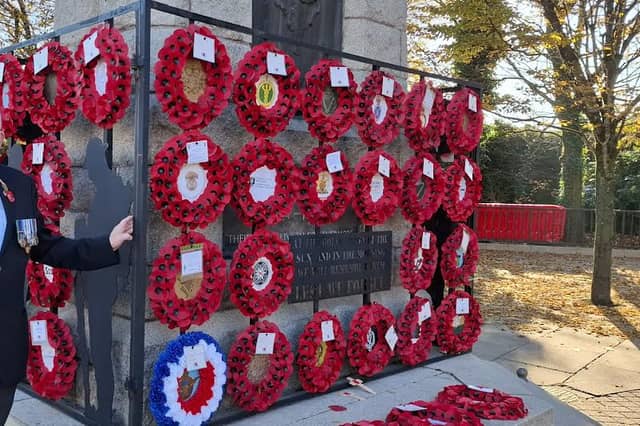

A deeply personal family story of sacrifice, friendship and reconciliation lies at the heart of Francie Pancott’s lifelong commitment to ensuring that those who gave their lives in war are never forgotten.
A deeply personal family story of sacrifice, friendship and reconciliation lies at the heart of Francie Pancott’s lifelong commitment to ensuring that those who gave their lives in war are never forgotten.
A heartfelt appeal has been made for greater involvement from local schools and Catholic communities in Omagh’s annual Armistice Day commemorations, amid fears that the moving ceremonies could eventually fade away without the next generation stepping forward.
Francie Pancott, who has devoted almost three decades to remembering those who lost their lives in the two World Wars and subsequent conflicts, believes it is vital that young people from all backgrounds learn about the sacrifices made and help carry the tradition into the future.
Speaking following last Wednesday’s Armistice Day ceremony at Omagh Cenotaph, Francie also called for more Catholic schools to become involved, stressing that remembrance should never be divided along religious or community lines.
His appeal comes from a deeply personal place, with his own family history shaped by the horrors of the Second World War and the enduring friendship between his father, a prisoner of war, and a Protestant soldier who never made it home.
Francie wants that message of shared humanity to be heard by the next generation.
"I would love to see the Catholic schools here. Because, as a Catholic, we were never taught the Second World War and this is not taboo. I have no problem with that," he said.
"I am also ex-service. I did what I wanted to do. From I was no age I wanted to join the Army and I couldn't have cared less what anybody thought, because it was what I wanted."
Francie believes that even a small number of pupils from each school attending would make a significant difference, rather than expecting entire year groups to participate.
He has already been visiting some primary schools to speak about remembrance and encourage children to take an interest, but fears that without their involvement the future of the ceremony cannot be guaranteed.
"Without the youth this won't happen. I do talks around some of the primary schools and I keep telling them to take up the torch. If they don't, this won't happen.
"There will be no wreaths, no standard, no band. I am afraid for the future. It will probably be the case because every year we can see fewer and fewer veterans."
It is a concern that is becoming increasingly evident in the work Francie undertakes every year.
Alongside Ronnie Moore and Richard Black, he spent the week before Armistice Day placing poppy crosses on the graves of those who died in war.
When he first began the work 27 years ago, they were looking after approximately 380 graves. This year, that figure had risen to more than 1,000.
The area covered stretches from Omagh to Carrickmore, Drumduff, Drumnakilly, Killyclogher, Grenmill, Cappagh, Lislimnaghan, Mountjoy, Dublin Road and Drumragh's old and new graveyards, as well as two aircraft crash sites.
When better weather returns, Francie also walks around the various graveyards, recording names to ensure that the details of those buried there are preserved for the future.
For him, it is far more than an annual act of remembrance.
"I do this because of my father. It's my way of saying thanks to him and all these men who gave up their lives," he explained.
War, friendship and sacrifice
The reasons behind Francie's commitment become even clearer through the remarkable story of his father.
His father was born on Belfast's Newtownards Road before moving to Brook Street in Omagh. His own father, Francie's grandfather, was a piano and organ builder who tuned the organ at Sacred Heart Church.
As a young boy, Francie's father would accompany his father to the church, helping to pump the bellows while the organ was being worked on.
But his life would later be shaped by the devastating events of the Second World War.
He was captured during the Battle of Leros and spent 18 months as a prisoner of war in Germany, not far from the Bergen-Belsen concentration camp.
During that terrible period, he formed a close friendship with a Protestant soldier named James McMaster.
The two men shared a particularly harrowing experience during the battle. They were sheltering in the same shell crater when James was killed, while Francie's father survived.
The loss stayed with him throughout his life, but so too did the friendship they had shared.
Francie recalled how his father would speak about the relationship and the lessons he believed people should learn from it.
His father's words were particularly poignant in the context of Northern Ireland's own troubled history.
"Hate got us into this carry on and hate carried on through the Troubles," he would say.
"The one thing James and me had in common, we both bled red. It wasn't orange or green and that's the way it should be. We should be able to get on with one another. We're only here for a short time."
Those words have remained with Francie and are central to the message he wants to pass on through his work.
For him, remembrance is not about politics, religion or division. It is about ordinary people who made extraordinary sacrifices, the friendships forged in the most difficult circumstances and the importance of learning from the past.
Service and remembrance
Francie's own working life has also taken him through several different paths.
Having fulfilled his ambition to join the Army, he later became a plumber before retraining as a driving instructor, a profession he pursued for 24 years before retiring.
His commitment to organising Omagh's Armistice Day commemorations is considerable, with preparations for this year's ceremony beginning back in September.
He believes the event must continue to bring people together, with schools, churches and the wider community all playing their part.
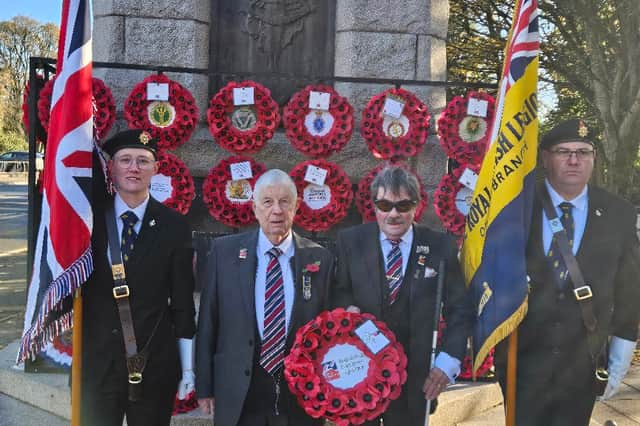
Last Wednesday's gathering at Omagh Cenotaph was organised by the Omagh branch of the Royal British Legion and brought together veterans, representatives of local organisations and members of the public to mark the 11th hour of the 11th day of the 11th month.
Omagh DUP councillor Errol Thompson, himself a former serviceperson, said it was important that everyone who had lost their lives in wars and subsequent conflicts was remembered, irrespective of religion or background.
"It's very important we continue to do this. I'm an ex-service person who served this town and all over this area and it makes me very proud to come and do this today," he said.
He also welcomed the presence of representatives from the Omagh Churches' Forum, describing their attendance as particularly important.
The ceremony marked the first official engagement for newly appointed Royal British Legion Omagh branch chairman Cyril Monteith, who had taken up the position just two weeks earlier.
He said he was pleased with the turnout despite the cold weather and the fact that it was a working Wednesday morning.
"It is important to remember those who died in the world wars," he said.
Also present were Legion standard bearers Karen Cobane and Derek Mills, piper Gordon Simpson, Ronnie Moore and Bertie Oliver.
Blind veterans organisation appeal
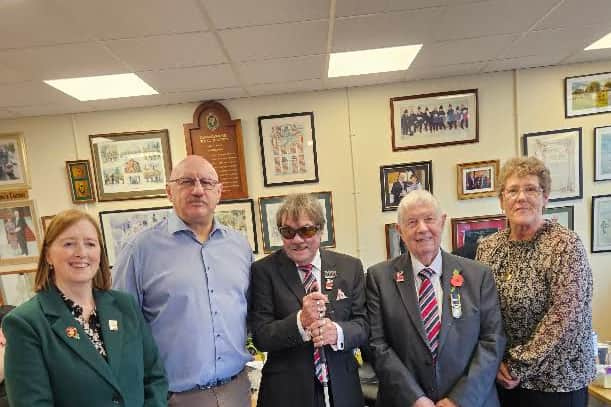
Another important feature of this year's commemoration was the first attendance of representatives from Blind Veterans UK, who used the occasion to highlight the support available to former service personnel experiencing sight loss.
The organisation has a presence in Northern Ireland, but community support worker Karen McKeown said many veterans were unaware that its services were available to them.
She is now appealing to former service personnel in Omagh and throughout Tyrone to make contact, revealing that the organisation currently has no registered members in the Omagh or wider Tyrone area.
"Blind Veterans UK has a presence in Northern Ireland, but that's not always known. We provide the same service as they get in the UK," she explained.
The organisation supports veterans who have lost their sight during wartime or as a result of their service, as well as those who have subsequently developed conditions such as macular degeneration, glaucoma or other age-related sight problems. It can also help where sight loss has resulted from an accident.
Karen stressed that someone does not have to be completely blind to qualify for support.
"In fact, most of our veterans have some level of sight. They are registered blind, but not totally blind," she said.
Last Wednesday was the organisation's first visit to Omagh, with two of its Belfast members, Alex and Walter, travelling to the town to lay wreaths and support the local veterans.
Karen said there were pockets throughout the country where the organisation had yet to establish contact with blind veterans and she hoped the visit would raise awareness of the help available locally.
"As a community support worker I can help them, assess their needs and help improve their quality of life.
"It's important for veterans to know we are here for them and I would appeal to any of them in this area to get in touch."
Veterans can contact Blind Veterans UK through its website at www.blindveterans.org.uk [email protected] or by telephone on 0800 389 7979.
Both Alex and Walter said they were delighted to visit Omagh for the first time and were impressed by the atmosphere surrounding the ceremony.
"Even though I can't see a lot, I could listen and pick up the great atmosphere," said Walter.
Alex encouraged other veterans to explore the organisation and the opportunities it provides, including its Somme Platinum Jubilee Veterans Community Garden, a therapeutic garden project developed on site.
Both men said becoming involved with Blind Veterans UK had made a tremendous difference to their lives and experiences.
As the wreaths were laid and the silence observed at Omagh Cenotaph, the morning served as a powerful reminder that remembrance is not simply about looking back.
For Francie Pancott, it is about ensuring that the stories of sacrifice, friendship and humanity are passed on - and that the names on more than 1,000 graves across the district never become forgotten.
His message is simple: the next generation must take up the torch, because remembering those who gave everything should never be left to the few.