

Newtownstewart man appointed Tyrone's new High Sheriff
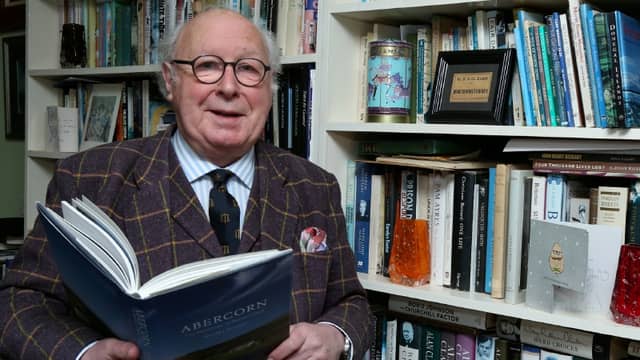

A 70-YEAR-old former law lecturer has just been appointed the new High Sheriff of County Tyrone by HM The King. David Moore of Woodbrook House, Deerpark Road, Newtownstewart said he was "very gratified and very proud" when he learned of his appointment. He succeeds Helen Anderson, a retired optometrist from Sixmilecross.
A 70-YEAR-old former law lecturer has just been appointed the new High Sheriff of County Tyrone by HM The King.
David Moore of Woodbrook House, Deerpark Road, Newtownstewart said he was "very gratified and very proud" when he learned of his appointment. He succeeds Helen Anderson, a retired optometrist from Sixmilecross.
The position of High Sheriff is a centuries-old public office that exists to this day but that many may know little about.
And it comes with a title some might associate more with Robin Hood or the Wild West than to life in the modern day.
"It's very personal for me and I'm very proud to have such a Tyrone based, Tyrone rooted and Tyrone orientate award. I've always been a proud Tyrone man and although I lectured in law at Queens for a while I came back here whenever I could and now I've been here for the past 20 odd years. The family have been here for many generations
Son of the late J. R. W. (Jackie) Moore from Woodbrook House and Majorie (née Smyth), Milltown House, Newtownstewart Mr Moore was born in the old Strabane Hospital. He has one sister, Pamela Coughlan, a former languages teacher who worked in the Foyle College in Derry who now lives in Limavady. He is married to Margaret, a former primary school teacher. She retired from Artigarvan Primary School and Community Nursery having spent other parts of her career in Dromore and Portavogie, Co Down.
The couple have four children, Charlotte, (40), Donaghadee; Louie, (38), Donaghadee; Jack, (36), Newtownstewart and Oliver, (33) Ardstraw and eight grandchildren, four in Tyrone and four in Co Down.
He attended Newtownstewart Model Primary School and Strabane Grammar School before moving on to Queen's University, Belfast where he graduated with a Bachelor of Laws in 1975. He then joined the Inland Revenue for three years as an inspector of taxes. He returned to Queen's in 1978 as a lecturer and stayed there for 25 years although continued with another role as a General Commissioner for Income Tax from 1989 until 2009 when the position was abolished. He retired from Queen's in 2003 and returned to his beloved Newtownstewart permanently at this stage. He has a keen interest in reading, music and modern art.
"I had plenty of Tyrone students during my 25 years there; many lawyers from Omagh, Strabane, Dungannon and elsewhere and it always pleases me to read of their achievements. I'm always very gratified by their successes and also gratified by the fact they remember me."
After he left Queens Mr Moore kept himself busy. He sat on the old Lay Panel for two years before being appointed a Lay Magistrate from 2005 and the first presiding Lay Magistrate for Northern Ireland for ten years (2006-2016) and sat in the Fermanagh-Tyrone Division. He was also a Tax Judge as well as a member of the Criminal Injuries Compensation Appeals panel which sat in Belfast. He retired from all these bodies in March last year.
"These kept me in contact with the legal world and what was going on in the county. I was involved in the family and youth courts in Dungannon, Enniskillen, Omagh and Strabane."
Outside the legal world Mr Moore was also a member of the Northern Ireland Water Council and became its chair when it was reestablished in 1999, the first government advisory body established under the Nolan Principles - the ethical standards those working in the public sector are expected to adhere to.
That lasted until 2007. Its last meeting was held in Mr Moore's house and was attended by the Duke of Abercorn.
"I took it a bit thick with them because I felt the only way they saw fit to deal with water in Northern Ireland was to get rid of the body that was independent and fit to advise them. What they really wanted to do with water in Northern Ireland was nothing. We had a strong European role to play within the European Water Framework directive. I held the last meeting for the members of the council at my home I kept the civil servants and Permanent Secretaries out because I felt it a bit hypocritical for them to come and tell us what great boys we were and how we were doing awfully well whenever they had just got rid of us when the body was at the point of delivering something really good."
The Office of High Sheriff is an independent non-political appointment for a single year. The origins of the Office date back to Saxon times, when the ‘Shire Reeve’ was responsible to the king for the maintenance of law and order within the shire, or county, and for the collection and return of taxes due to the Crown.
The Local Government (Ireland) Act 1898 allowed for the appointment of High Sheriffs in Northern Ireland and today there are eight sheriffs in Northern Ireland; one for each county, and one for each county borough, i.e. the cities of Derry and Belfast.
Here, the appointment is officially made by the Secretary of State on behalf of the King. An outgoing High Sheriff nominates their successor, except in Belfast where councillors put forward a nominee, who is always a serving member.
The incoming High Sheriff is then officially notified by letter and is sent a warrant of appointment signed by the Secretary of State and a ‘declaration of sheriff’, which has to be sworn before a Commissioner of Oaths at an official ceremony.
Mr Moore's appointment became effective on January 1 but he was only sworn at an informal ceremony at a solicitor's office in Omagh on January 8.
In relation to his new role Mr Moore is looking forward to being able to do what he is asked to do.
That role includes being invited to greet members of the Royal Family or Heads of State if they visit Tyrone, and receiving a High Court judge should they be presiding at a court in the county. Informally, the Sheriff may also receive a range of invitations to social and ceremonial functions in the area.
"You are principally the King's legal representative in the county and notionally responsible for the preservation of law and good order. All that used to be important when judges came out on Assizes or the Circuit then the High Sheriff would be involved in looking after them on behalf of the county or technically I suppose on behalf of the King.
"We don't have that anymore but if a High Court judge was coming to sit in the county it would be the Sheriff's job to meet and greet and in fact sit with him on the bench, at least for the start of any hearing he was going to do. But the whole thing now is mostly ceremonial without a chain-of-office, uniform or any of the sort of trappings one might associate with the role.
"There's no business like the Sheriff of Nottingham, which was exactly the same position. There's no making sure the judge's requirements were carried out because they had a very chequered history. They could collect taxes but could also cream off what they wanted themselves as long as they sent the right basic amount in," he joked.
He added the one thing a High Sheriff has to do if there is a change of monarch, he or she has to proclaim the new King or Queen to the county - something former High Sheriff Emer Murnaghan had to do in 2022 from the courthouse steps in Omagh.
"I'm now more interested than I ever was in the health of His Majesty. If he survives for many year I'll be more than happy for personal and loyal reasons."
Looking back over his life Mr Moore believes we have been living in historic times with so much happening in the world over the past 70 years. He recalls how the A5 roadway hasn't really changed, how the trains had ceased running and how many other changes have dominated everyday life.
"Without having to practice law, which I decided not to, I've been very lucky to be part of the legal system and judicial family; manage my career and do what I wanted to do but always with a focus on Tyrone."