

Feeling niece's heartbeat the most harrowing memory - Survivor
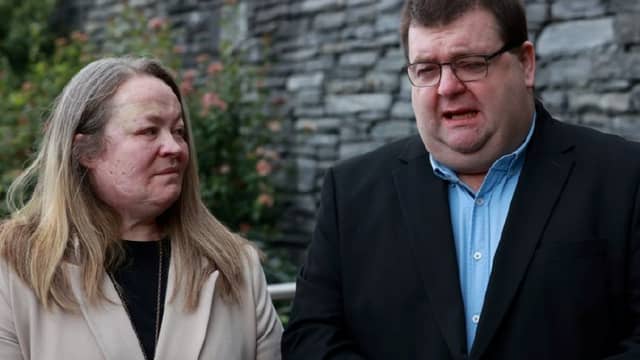

FEELING his niece's heartbeat on his chest is one of the most harrowing memories Omagh bomb survivor, Garry McGillion, relayed at this morning's sitting of the Omagh Bombing Inquiry. Mr McGillion, then aged 24, had been in town on that fateful day of August 15, 1998 with his fiancee Donna-Marie, sister Tracy and baby niece Breda Devine, aged 20 months, to buy a pair of shoes for their wedding which was due to take place one week later on August 22.
FEELING his niece's heartbeat on his chest is one of the most harrowing memories Omagh bomb survivor, Garry McGillion, relayed at this morning's sitting of the Omagh Bombing Inquiry.
Mr McGillion, then aged 24, had been in town on that fateful day of August 15, 1998 with his fiancee Donna-Marie, sister Tracy and baby niece Breda Devine, aged 20 months, to buy a pair of shoes for their wedding which was due to take place one week later on August 22.
Describing the bomb explosion as feeling like a 'massive electric shock', Mr McGillion said he could hear 'piercing screams', alarms going off and people desperately shouting for their loved ones.
Despite the severity of his own injuries, including a hole in the back of his head and some of his clothing on fire, Mr McGillion immediately set out to try and find his now wife, sister and niece, who was to be a flowergirl at the wedding.
Finding his family was his 'main priority', he told the inquiry.
Amid the 'piercing screams', he was able to hear his sister's voice and then found Donna-Marie lying on the ground with a shop sign on top of her.
Having managed to pull them from the rubble, he then ran with his niece in his arms to find her medical attention.
Still breathing, Mr McGillion said he could feel her faint heartbeat and knew she needed urgent help.
He handed her over to a traffic warden who conveyed her to hospital.
He then went to go back for his fiancee and sister but was stopped by police officers who told him he needed to go to hospital due to the seriousness of his own injuries.
Recalling the 'harrowing' memory, he said to this day he can "still feel Breda's heartbeat on my chest".
The bombing “altered and changed every aspect of my life”, he said.
Mr McGillion had suffered third degree burns to the right hand side of his body and his head, as well as shrapnel injuries to his legs.
He also lost part of the muscle in the upper part of the right arm and his ear drums had been blown.
In the weeks that followed he underwent extensive plastic surgeries, the physical pain of which was “unbearable”.
However, he told the inquiry that the pain much worse than that, was the pain and devastation of being told his niece had died.
He said he felt as sense of 'survivor's guilt', adding that the guilt of his little goddaughter not surviving would be "something I’ll carry with me until the day I die”.
The extent of his own injuries also meant Mr McGillion never got the chance to 'say goodbye' to little Breda. Instead, he visited her grave after leaving hospital.
"Why was Breda not spared, why was I spared?" he said. "I had lived 24 years of my life; she had lived 20 months."
His wife, Donna-Marie, was the next person to give evidence.
One of the most seriously injured, Donna-Marie McGillion was in a coma in the Royal Victoria Hospital for over six weeks with a 20 per cent chance of survival.
She had been given the 'last rites' by clergymen on four occasions.
Aged 22 at the time, Donna-Marie said she has little to no memory after the explosion.
She said she didn't hear a bang but could remember hearing the screams and cries of others around her as she lay trapped on the ground.
Today, the sound of sirens takes her 'right back' to that day and the feeling of helplessness.
She praised her husband for his bravery and for finding them so quickly.
Her first memory after that day was waking up six-and-a-half weeks later.
“I have no idea when I got the hospital...of what happened," she said.
Mrs McGillion said her family were told to prepare for the worst and upon arrival at the Royal Victoria Hospital in Belfast was placed in an induced coma.
When she awoke six weeks later in intensive care, she said her family were around her bed.
At first she believed she had been in a car accident.
Mrs McGillion suffered 65 per cent third degree burns to the front and back of her upper body, her face, arms, hands and lower legs, as well as shrapnel wounds, a large forehead laceration and a damaged eardrum.
Speaking of her recovery process, she said the burns unit would always haunt her.
She said she “lost count” of the number of surgeries she has underwent.
Describing the past 26 years as an 'ongoing struggle', Mrs McGillion said she suffered two heart attacks and is in daily pain.
Six months after the bomb Donna-Marie and Gary were married by the two priests who had previously given her the last rites.
In the back of her mind she says "there was someone missing".
Breda's death will "haunt us forever", she said.
Commenting on the compensation system, Mrs McGillion described it has a 'harrowing and difficult' due to the constant 'having to prove'.
Of the public inquiry, she said that whilst "we are never going to move on", the families "need closure".
“I can’t do this in five, 10 years’ time,” she said.