

Fascinating history behind the Provincial Bank of Ireland in Omagh
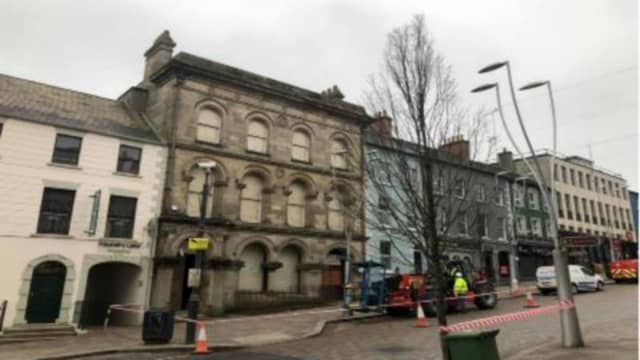

OMAGH historian, Kenneth Collins, this week examines the history behind the Provincial Bank of Ireland in Omagh and how it established itself and looks forward to the building adding a new dimension to the town's streetscape in the not too distant future. The Provincial Bank of Ireland was founded in 1825 in London by Thomas Joplin along with a group of 689 shareholders and they commenced operations that year in Cork with the main aim of introducing English Capital into Ireland outside the Dublin area.
OMAGH historian, Kenneth Collins, this week examines the history behind the Provincial Bank of Ireland in Omagh and how it established itself and looks forward to the building adding a new dimension to the town's streetscape in the not too distant future.
The Provincial Bank of Ireland was founded in 1825 in London by Thomas Joplin along with a group of 689 shareholders and they commenced operations that year in Cork with the main aim of introducing English Capital into Ireland outside the Dublin area.
The old established Bank of Ireland had for many years held the monopoly of banking business within a 50 mile radius of Dublin and did not expand its branch network much further outside the area, The Provincial took advantage of this situation and became the pioneer of branch banking throughout Ireland.
One year later their first branch office was opened in Dublin and as the bank prospered this was followed by expansion into the main towns and cities throughout Ireland.
A few years elapsed before a branch was opened in Omagh in October 1834 which was in fact the first banking facility in the town and was located in Main Street around where Primark is today.
It is of interest to note that from 1825 the Provincial commenced printing its own initial currency of 25 shillings, 30 shillings, £1, £2, £3, £4, £5, £10, £20, £50, and £100.
In the early years it was customary to include the local branch name on the notes and yes, Omagh had its own banknotes with the name proudly displayed in the bottom margin but this practice was discontinued from 1920. Also in 1929 the bank had to change all its notes from payable in Dublin to payable in Belfast and any uncirculated notes had holes punched in them to cancel their legal tender. An old one pound note with the perforations would sell for around £60 today.
From 1834 the bank continued to become very successful and well established throughout Ireland and it was during the term of Omagh branch manager Jas F Alexander in 1864 that plans were made to erect a new prestige building from which financial business would be conducted in the town.
The official architect employed by the Provincial Bank at that time was William George Murray who was a Fellow of the Royal Institute of Irish Architects and he worked from his father's practice in Dublin.
It is interesting to note that he was also the appointed architect acting for the Dundalk Enniskillen and Londonderry Railway Company designing stations on this line.
William Murray had already drawn up plans for several distinguished bank buildings for the Provincial in Cootehill 1858, Athlone 1861, and when undertaking plans for the Omagh branch was also engaged in the design of the large and ornate Italianate Plazzo style bank building in Cork which with nine bays has been described as one of the most magnificent buildings in the city.
The site in Omagh was well chosen near the bottom of the hill on what was Main Street at the time dominated by the Courthouse built in 1814 and the White Hart Hotel sometime before 1824.
This area was already the business hub of the town and fast developing as many of the essential traders had their premises here where the bustling hiring fairs were held each month. Improvements to the area had been made in 1861 when the local Assizes had given their approval for the main streets of the town to be flagged with the comment that this would add to the respectable appearance of the town.
The design that William Murray prepared was on a much smaller scale than his masterpiece in Cork but nevertheless a very attractive building in the Italianate Classical style having four bays and three storeys, rounded arch windows on the ground floor, two entrances of the same style with leaf ornament capitals. The centre pair of windows with Corinthian columns and the upper floor windows of similar style, floor lines defined with string courses and the upper part finishing with a frieze band, cornice and parapet wall at roof level. Two circular stone sculpted plaques to be included depicting the Bank's initials and the date of completion.
There was also a basement with street level windows gaining light from a space enclosure below ground level in the front footpath protected with an iron grill (now concreted over) and ornamental cast iron railings to prevent anyone from falling into the space. The main banking area was on the ground floor with spacious residential accommodation for the manager on the upper floors. The specification called for the Buff Pink cut sandstone to sourced from the Dungannon Quarries and secondary stone of polished red granite.
When completed the building was a worthy architectural addition to the area and was reported to be the highest Victorian building in Omagh at that time.
The new bank under the management of Jas F. Alexander would have had a very successful start in the town with the number of business accounts on its doorstep and progress continued throughout the years with successive managers, Wm. McCullough, A. Sproul, J. A. McFarlan, W. B. Baker, W. |H. Giles, right up to the 1940s when Tom Patterson was in office.
The writer had his first visit to the Provincial Bank in 1946 as a junior clerk in the employ of Omagh Gasworks assisting with the lodgement of coins collected from the gas meters. Having a keen interest in woodwork I could not help but notice the design and high quality of workmanship in the interior especially the oak counter and the manager's office enclosure.
Several years later as a joinery apprentice in the employ of J.C.White Building Contractor Riverdale I was again at the bank with the workforce engaged on an extensive maintenance contract involving exterior and interior repairs including slatted snow support boarding for parapet and chimney back gutters, replastering of internal walls, reinstating plaster moulded cornices, replacing decayed flooring and skirtings, repainting, etc.
The ornate moulded plaster cornices were skillfully patched and run by plasterer Raphael McGuigan using a pattern 'Horse' constructed by myself under the direction of J C White The work when completed was considered to play an important part in the preservation of the building at that time.
The contract was not without incident as one of the workforce a young plasterer named John Worling unfortunately fell while working off a ladder and was seriously injured. In time he recovered but never again returned to work. In those days in the absence of Health and Safety rules scaffolding was very basic and two and three extension heavy wooden ladders were in common use to gain access to the upper levels of a building.
In more recent times a company specialising in the restoration and conservation of heritage buildings was contracted to carry out works on the bank including exterior steam cleaning of the walls, stone replacement, and lime mortar pointing all to ensure the continued preservation of the building.
Changes in the banking world in 1966 brought about the amalgamation of the Provincial, Munster and Leinster, and Royal Bank of Ireland in what was to be known as the Allied Irish Bank which continued business in the premises at 15/17 High Street.
Change was to come again in 1991 when the Allied Irish Bank merged with the Trustee Savings Bank to become the First Trust Bank eventually moving its business to the old Munster and Leinster Bank premises across the street. The end of an era was finally to arrive when the First Trust Bank closed its doors for business in Omagh on November 12, 2021.
The old Provincial Bank now standing proudly for 160 years had been lying vacant for some time and in 2020 a local company purchased the building with a view to converting it into a boutique hotel. Planning approval has just been granted for what is a £5 million plan to transform the historic building into the boutique hotel with 22 bedrooms, 100 seat restaurant, a whiskey bar, and a rooftop health and well being area with panoramic views of Omagh and beyond.
Omagh Heritage Forum is delighted with the welcome news of the future preservation of this architectural gem in the town centre and look forward to its progress and when complete perhaps pay a visit to the whiskey bar and raise a glass to the enterprising developers and builders past and present.
Footnote:
Omagh is not alone in the preservation of Provincial Bank buildings as the magnificent 7 bay branch in Royal Avenue Belfast built in 1865 closed in 1996 was let to Tesco for 25 years and has now been purchased by the City Council for conversion into a Community Recreational and Cultural space for the citizens of Belfast Provincial Bank of Ireland Royal Avenue, Belfast.