

Department lays blame on 'historic under investment' as local pothole reports soar
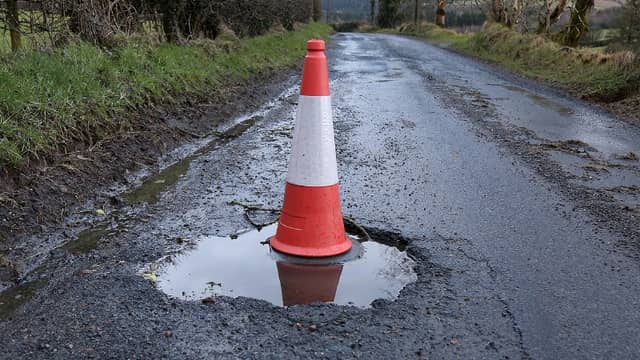

THE DETERIORATION of local roads resulting from "historic under investment" has seen well over 300 potholes reported locally this year alone.
THE DETERIORATION of local roads resulting from "historic under investment" has seen well over 300 potholes reported locally this year alone.
According to analysis of recent Department for Infrastructure (DfI) statistics, from Sunday, January 1 to (yesterday) Tuesday, a total of 337 potholes had been reported in Fermanagh and Omagh.
And figures show that this year's volume of reports have vastly exceeded those lodged in the same period last year, as only 135 pothole reports had been made to DfI from January 1 and February 6, 2022.
Overall, there were 4,089 potholes reported across Northern Ireland last month, which was again more than double the number reported in January 2022.
According to DfI, the dire situation on local roads is the result of "historic under investment" in maintenance, which has led to the present deteriorating of road networks.
And many motorists are experiencing first-hand the often dangerous impacts of the crumbling road network.
Last week, DfI were contacted after a local driver who was forced to swerve to avoid a "crater" on the Beltany Road, outside Omagh, while number of cars were damaged due to a large pothole on the Plumbridge Road (B47), which has since been filled.
Ulster Unionist councillor, Rosemary Barton, has called on major road defects to be addressed urgently, and has said that that the poor state of local roads is increasing the number of costly compensation claims from motorists.
"After a prolonged period of frost and icy roads, many of which have received minimal attention from the winter gritting program, a large number of defects have appear, leaving vehicle drivers at the mercy of particularly deep potholes," councillor Barton said.
"There needs to be a greater frequency of inspections of the rural roads, many of which are subject to very heavy traffic, such as milk collection vehicles, larger meal lorries and generally a higher frequency of traffic now given that it is extremely difficult to get planning permission on to arterial routes which are the routes that are scheduled on the winter gritting programme.
"Many of the rural roads which have weaker foundations were never intended to carry heavy vehicles or be subject to increasing volumes of traffic, have become somewhat neglected over the years.
"The increasing problems with our rural roads is very evident with the increasing number of successful compensation claims for damages that have been made against the DfI as a result of poor road conditions."
But despite calls for DfI to urgently address an ever-growing intray of defects, it appears that the body is increasingly lacking the financial resources to do so.
According to a DfI spokesperson, recent budget cuts have been experienced, which has reduced hit maintenance activities.
This is a coupled with what has been described as "historic under investment" which has seen only the "highest priority" defects across the road network are currently being repaired.
“There has been historical under-investment in the maintenance of the road network for many years resulting in the deterioration we are now experiencing," a DfI spokesperson said. "More recently because of budget cuts the Department has had to reduce its routine maintenance activities to a ‘limited service’ which prioritises delivery of essential services for maintaining public safety.
"Consequently, only the highest priority defects across the road network are currently being repaired.
"Regular inspections of the road network are continuing and defects which meet the intervention level will be taken forward for repair."
The spokesperson continued: "In any given year, the number of potholes/surface defects reported depends on a number of factors including the appetite of the public to report.
"It can’t be assumed that the numbers reported necessarily reflect on the relative condition of the network compared to other years or in other Council areas.
"It should also be noted that the figures are for the number of pothole/defects reported, so in theory one pothole or defect can be reported several times, particularly in densely populated areas or where there are higher levels of traffic. On inspection many do not meet the criteria for repair."