

Council launches new four-year Corporate Plan
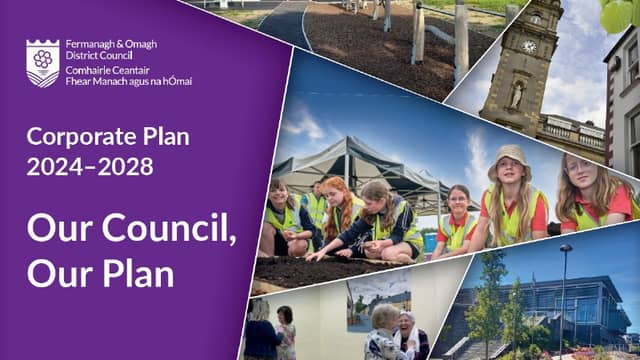
FERMANAGH and Omagh District Council faces many challenges over the coming four years but is confident that its new 'Corporate Plan, Our Council, Our Plan 2024-2028' sets out a strategic direction and identifies the key priority areas and associated actions to deliver on for the district. The overarching priorities are climate action, people and communities, shared prosperity and one council.
FERMANAGH and Omagh District Council faces many challenges over the coming four years but is confident that its new 'Corporate Plan, Our Council, Our Plan 2024-2028' sets out a strategic direction and identifies the key priority areas and associated actions to deliver on for the district.
The overarching priorities are climate action, people and communities, shared prosperity and one council.
The plan, which was launched recently, recognises the climate and ecological challenges, geopolitical uncertainty, difficult financial circumstances, significant cost-of-living and inflationary pressures and the levels of funding needed in the future and admits it will have to make tough decisions around where they prioritise and spend their resources.
However they are also keen to address the lasting and ongoing impacts of these challenges by being forward and outward looking.
Key actions have been identified in the 29-page plan to ensure the priorities are achieved with the aim of improving the lives and wellbeing of our residents and providing the best quality experience for visitors.
In developing the plan, the council says it was fully aware of the significant and ongoing demands faced by residents and businesses over recent years. These challenges have ranged from the Covid-19 pandemic to geopolitical uncertainty and the cost of living and cost of doing business crisis.
The plan acknowledges that while the council is the largest in Northern Ireland, covering 3,000km², it also has the smallest population, 116,926 in 2023, with 70% of people living outside the two main towns of Enniskillen and Omagh.
Population
It also points out that while the population has grown by 3.2% since 2011, compared to 5.1% growth at the NI level, its demographics are also changing, households are getting smaller, and the population is getting older.
While not unique it is still a change from what has been experienced over the past 30 years and therefore provides challenges with regard to service delivery for older people and ensuring suitable labour supply.
It says while general health and educational attainment are favourable compared to other regional averages, a range of inequalities also exist.
One in five of the population live in relative poverty. In localised areas of deprivation within the district, life expectancy and academic attainment are lower than the Northern Ireland average. The incidence of people suffering from multiple illnesses at the same time, is also growing and these complex health needs impact service demand and delivery. In addition, the centralisation and erosion of wider public services has adversely impacted the district.
Economy
The new plan also highlights that while at a headline level, the local economy has fared well in the past decade it remains less productive than the national average and is highly concentrated on microbusinesses. Challenges include the longstanding infrastructure deficit in Fermanagh and Omagh with an absence of railways, no motorways and only 0.6km of dual carriageway.
It adds that while the picturesque landscape and large rural topography are a source of great local pride, the natural environment is continually under threat. Locally, greenhouse gas emission levels have fallen steadily since 2005 but remain higher on a per head basis than the NI average. This is due in part to the size of the district, the large road network and its reliance on primary industry. Just under one half of household waste generated in Fermanagh and Omagh is recycled, and the recycling rate has plateaued in recent times.
There is significant built and natural heritage, but evidence suggests that there is significant heritage at risk.
Looking at its targets the council says it will invest in new ways of working to make the best use of the resources available and to enable them to invest in services, facilities and in their local places.
These, they say, will also present opportunities to be innovative and come up with new ways of working with more efficient means of delivering services to ensure that we retain the high standards of provision that residents expect.
Council chairperson, Cllr John McClaughry, said they recognise the need to continue to be inclusive and adaptable and strive for continuous improvement to meet the changing needs of the residents and the wider social, economic and environmental landscape.
“I look forward to seeing the actions being progressed over the next four years to ensure that our District is a great place to live, work, visit and invest in,” he said.
The council has robust performance management arrangements in place, which will apply to the monitoring and reporting of progress against this Corporate Plan 2024-28 It will report on its performance every six months and publish an Annual Performance Report on its website in September each year
You can examine the detail in the Our Council, Our Plan 2024-2028, by visiting the council’s website: www.fermanagh
omagh.com