

Community resilience the key to ending Fintona's tide of flooding woes
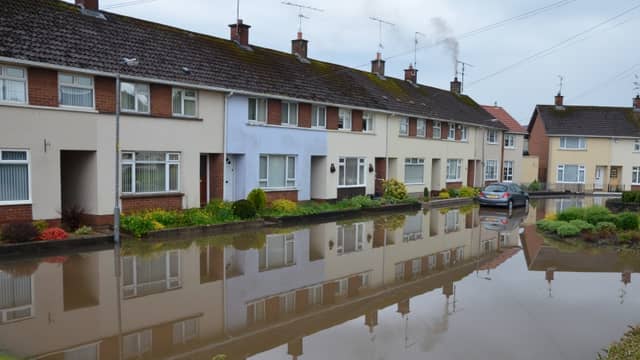

UNDERSTANDING the potential for a flooding incident is one thing, managing it is another. Over the years heavy, persistent and widespread rain has placed the village of Fintona in jeopardy. It has not been helped by out of date infrastructure or the slow pace of remedial action but long-term ambitions to create a space more resilient to future flood risk is what drives locals to find a solution.
UNDERSTANDING the potential for a flooding incident is one thing, managing it is another.
Over the years heavy, persistent and widespread rain has placed the village of Fintona in jeopardy. It has not been helped by out of date infrastructure or the slow pace of remedial action but long-term ambitions to create a space more resilient to future flood risk is what drives locals to find a solution.
Armed with local knowledge, community spirit, a get up and go attitude as well as thousands of sandbags, the Fintona Community Resilience Group have battled the elements with a unique brand of flood prevention moves that not only saves property but is also pretty adept at transforming bureaucratic red tape into a bridge to cross all sorts of flooding obstacles.
The committee has over the past 12 years or so witnessed the paradigm shift to more distributed flood risk management strategies that prevents under-threat areas from being submerged and properties damaged.
But as the locals continue to build resilience to future flood risk, with the support of the various government agencies in tow, learning to live with water always provides ongoing challenges.
Fintona's challenges stem from a small river named the Quiggery Water, whose source is located on the northern slopes of Murley Mountain and when it brings flooding through the village via bridges crossing it at Kiln Street and Mill Street as well as just outside the village at a location known as the Carnlea crossroads, its escape routes are imperfect and flooding occurs.
Two members of the local community resilience team, Paul Johnston, the Pastor at Fintona Independent Methodist Church and local businessman, Charlie McConnell believe with the right push from the authorities and further investment, their area could be saved from future flooding incidents.
They believe water that flows into their area from the Dromore Road during heavy rain simply can't get away quick enough and is not helped by an underground stream which is flowing from higher areas of the village such as Ashfield, McGaughey Terrace, the top of Main Street and the Tempo Road.
The underground stream empties into the Quiggery River below the Kiln Street Bridge, through a large flap valve. It is built at the same level as the river bed, and is designed to close during a flooding incident.
"When the flap is closed where is the surface water going to go? When they designed it they said there would be enough space in the underground system to hold it for 24 hours but when it comes in the bad rain we're flooded after an hour," says Charlie.
Major incidents
The Fintona residents saw their worst recent flooding over the past 12 years or so. They had to deal with two major flooding incidents inside a week in 2011 that saw a total of 21 properties flooded. This prompted meetings involving local residents, the Red Cross and various statutory agencies including the PSNI, Fermanagh and Omagh District Council, Northern Ireland Water and the Rivers Agency.
"They asked us to form a resilience group to work with them in future flooding incidents as they can not respond to every incident as these tend to happen in many locations around the same time," added Pastor Paul.
The agencies assured the new group that they would provide back up when they could and this was agreed on the understanding the various agencies would look at the water system infrastructure in the town. The agencies responded by inserting a River Monitoring Station and building a new drainage system for the storm water coming from the Fivemiletown / Clogher Road areas.
The monitoring station was installed just above the Kiln bridge by the Rivers Agency and links were established with the Met Office and the Department for Infrastructure (Rivers) who issue warnings as appropriate.
"Sometimes freak weather cannot be predicted by even the Met office as we found out during more flooding in July 2023 but but a combination of local knowledge and the River Monitoring Station allowed time to alert residents a flood was coming. We have a few members of the group who know weather signs and flooding patterns and are able to forecast when floods are potential trouble," added Charlie.
Pastor Paul stressed they are always keen not to cause unnecessary alarm.
"Some years ago, we received 29 rain warnings from the Met Office during one month, yet we never had a flooding incident so that's why it's vital the local community is involved and helps us all understand how to read the signs and cope accordingly. Thanks to our experiences we have got to know the rain patterns, what to expect, if the river can cope and how to deal with things if the frequency of the rain increases."
The Fintona group has developed a system of contacting all areas in the village that could be affected. The new water infrastructure has changed some things, so the group is seeking to adapt to the new patterns of danger if need be. This was the case during their latest no warning flooding incident last July.
"We did not have to do any sandbagging at Patterson Park, usually one of the worst areas affected this time but Meadowbrook was flooded so we have to look at how that happened and plan for the future," adds Pastor Paul.
The local committee have specific concerns they would like the various agencies to act upon and while they respect the challenges posed by no Executive and strict environmental laws and considerations, they feel unless they can force substantial changes, Fintona's flooding will never truly go away.
"We like to think we work well with the agencies and for the most part they have come around to understanding where we are coming from. Proof of this was the £1.5 million scheme they developed for the village, and we were grateful for it, but you could spend the same again trying to alleviate the problem," says Charlie.
He adds the old pipe network is very different to the newly installed version and combined with different sizes and regulations, there can be problems. The old storm drains combined different sizes of pipework according to the regulations in force at the time they were installed, creating many problems. The new system is very different.
Progress
The committee has identified this and a number of priority targets for their upcoming meeting with agencies and will be hoping to see progress.
The Fintona Community Resilience Group has been praised for their endeavours at recent meetings of Fermanagh and Omagh District Council and other communities have been urged to follow their lead if affected by flooding issues.
However, as the Fintona group points out flooding is the most pervasive among natural disasters, yet its costs are routinely underestimated. As climate change, economic and demographic trends, and a chronic lack of investments in resilience combine to drive risk higher, it is time to rethink our approach to flood risk.
Today, villages, towns and even cities must withstand more than ever before. Population growth puts water infrastructure under pressure, making it hard to balance supply and demand. The climate crisis brings more extreme weather, with frequent heavy rainfall increasing flood risk.
To be resilient in the face of these threats, communities need effective flood management and a future-proofed water supply. Economic development and population growth, more frequent and intense flood events are putting a greater proportion of people and infrastructure at risk. The people in Fintona know this only too well and feel now is the time for action.