

Campaign launched to save Omagh's ancient graveyard

A CAMPAIGN has been launched to save one of the most ancient graveyards in the Omagh area. This small plot of land in the centre of the town is the last resting place for those affected by the Famine. It is believed that there could be in excess of 2,000 souls who lie in unmarked graves near the site of a workhouse less than an acre in size that has been neglected for decades.
A CAMPAIGN has been launched to save one of the most ancient graveyards in the Omagh area. This small plot of land in the centre of the town is the last resting place for those affected by the Famine.
It is believed that there could be in excess of 2,000 souls who lie in unmarked graves near the site of a workhouse less than an acre in size that has been neglected for decades.
Now however local historian Kenneth Collins and colleagues in the Omagh Heritage Forum Group are determined to ensure these long -forgotten victims are remembered in respectful and meaningful way.
Mr Collins believes it’s hard to actually get across to people the scale of the disaster in Omagh and surrounding areas and feels it is important that the people who died in the workhouse system in this area be remembered.
"The famine drove people into the workhouse but the overcrowding and the disease is what ultimately caused so many deaths.
"For me as a local historian, a lot of it is just to be reminded of the scale of the famine. As communities we’ve forgotten how traumatic the famine was and this project is fantastic to bring it back into the public eye again."
The Omagh Union Workhouse Complex of stonework buildings erected on a six acre site between St Julian's Road and Woodside Avenue first opened its doors on August 24, 1841.
In the first few years there were only a few hundred admissions but in common with all Irish workhouses this figure was to change dramatically with the arrival of the Famine in 1845 which led to a massive increase in the numbers entering the institutions bringing the system into crisis with overcrowding sometimes to double or treble the designed capacity of the buildings.
"The results of this could be compared with the recent pandemic of Covid and indeed worse with occupants sleeping side by side in the dormitories generally with low standards of hygiene causing the inevitable outbreaks of highly contagious fevers such as typhoid and dysentery which sadly instigated a very high death rate lasting for over five years in most if not all of the 163 workhouses throughout Ireland. It is on record that approximately 250,000 people died in these workhouses between 1846 and 1851," said Mr Collins.
Omagh like all workhouse complexes included an infirmary with the attendant medical officer and nursing staff to tend to the sick but this accommodation was rapidly overwhelmed as the crisis developed and around 1847 a new separate Fever Hospital was built at the rear of the workhouse next to a sizeable plot which had already been established in earlier years as a burial ground. This hospital in later years became known as Omagh General Hospital.
Workhouse hospital
In spite of the medical care available in the workhouse hospital, the high death rate was unstoppable and to give an example in neighbouring Dungannon Union Workhouse between March 4 and June 21, 1847, a total of 270 occupants died with the worst day on May 8 when 15 passed away. The fevers did not discriminate between young and old, male or female, or religious persuasion In the first six months of 1847 a total of 54 Workhouse staff in the Irish Unions died whilst engagaged in their work including Medical Officers, Board Clerks, Masters, and Chaplains..
Mr Collins outlines how the graveyard faded into obscurity.
"During this period the Omagh plot would have seen a large number of its occupants buried there in communal, unmarked graves which eventually over the years caught up with the space available as a century later in 1947 during excavations for new buildings quite a number of unknown burials were discovered outside the plot on the other side of the hospital.
"It is difficult to determine the exact number of burials in any of the workhouse graveyards as the Board of Guardians informed the deceased's relatives of the death and they had the option of taking the remains for a private family funeral elsewhere but this fact was generally not recorded. Based on the written records of other similar Unions the burials in the Omagh plot could be estimated at around several thousand."
In 1948 Mr Collins was an apprentice joiner on the workforce employed by local builder J.C. White on a contract for the erection of an 11-bed maternity wing being added to the Omagh General Hospital on the workhouse site.
"It was during this time that I became friendly with one of the last elderly employees of the workhouse staff and he showed me the location of the burial ground and related a story about the burials and the coffin having a hinged bottom so that it could be reused. I still doubt the authenticity but have seen similar stories in other reports.
"The Omagh workhouse system closed down around 1948 although the buildings remained and were used for other purposes but the General Hospital was open and active for another 50 years dealing with elderly patients and maternity services but the burial ground and its location over the years was largely forgotten.
"The first major demolition of the main workhouse buildings began in 1962 with the removal of the admissions block to prepare the way for a new P.S.V. testing station built in 1963. This was followed in 1967 by the removal of the dormitories, infirmary and all remaining workhouse structures to prepare the site for the erection of a new government training centre erected in 1968. The demolition was efficiently carried out by local contractor John Breen and the only remaining building on site now was the General Hospital.
"The next new development on the vacant part of the workhouse site next to St Julian's Road was substantial in the form of St Julian's House which was a 44-unit sheltered housing complex constructed in 1996.
"The General Hospital itself was finally demolished around 2006 and it is difficult to believe that the stone and concrete block rubble from the walls was deposited over most of the old established workhouse burial plot and remains there to this day. It is to be hoped that the demolition contractor at that time was unaware of the graveyard area and of course there were no markings to indicate otherwise.
"The progressive development now moved nearer to the old General Hospital cleared area and the adjoining burial ground but problems began to surface for the proposed erection and associated car parks of Early Years Learning Centre built in 2007 and Avalon House Children's Respite Centre built in 2011."
Due to the proximity of the original burial plot which obviously was to remain untouched an archaeological team from Queen's University was engaged intermittently on the site from 2007 to 2012 to ensure no encroachment on burial areas.
"Their excavations surprisingly revealed a number of graves outside the established plot on the opposite side of the old General Hospital which as before mentioned was an indication that at some stage the old burial ground was filled to capacity and it was also confirmed that these burials were contained in wood coffins.
Skeletons removed
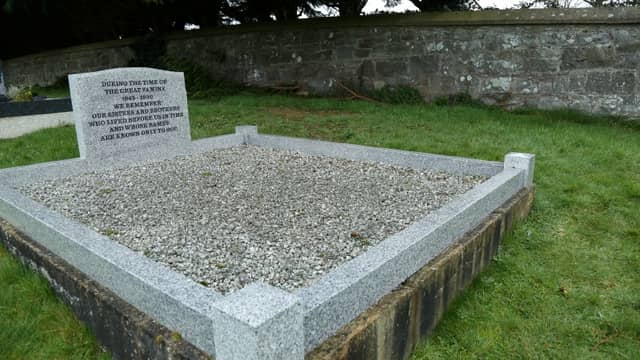
"On June 16, 2011 to enable the completion of the above buildings a total of 79 skeletons were removed from the area and re-interred in a plot in the Omagh Dublin Road Cemetery with a special service conducted by the Omagh Churches Forum. A nice headstone marks the plot recording the dates, 1845-1850 during the famine time in remembrance of those interred although no mention is made of their previous resting place."
Moving on to the present day Mr Collins is now a member of the Omagh Heritage Forum Group which was founded last year by local historian Vincent Brogan and like minded enthusiasts interested in preserving the historical heritage of Omagh. The Forum meet each month in the Omagh Community Centre.
The restoration of the old Omagh Union Workhouse burial ground is now on its priority list and they have visited the site and met with Cllr Barry McElduff of Fermanagh and Omagh District Council along with representatives of various authorities involved in the project. It is hoped that in the near future the site will be cleaned up by removing the rubble covering the graves and a small memorial garden created with illustrated signage to identify the cemetery and the now demolished adjoining hospital and workhouse in which so many of the old Omagh Union citizens lived and died.
This would follow the excellent example of Dungannon District who recently constructed and opened a respectful memorial garden complete with a meaningful headstone on their old workhouse burial ground.