

Bovine TB, protocol and ammonia woes in focus as UFU President's Roadshow comes to Omagh

THE ULSTER Farmers' Union (UFU) has called on local farmers to get fully behind new measures designed to drastically reduce highly-polluting ammonia emissions on Northern Ireland's farms.
THE ULSTER Farmers' Union (UFU) has called on local farmers to get fully behind new measures designed to drastically reduce highly-polluting ammonia emissions on Northern Ireland's farms.
The call for action, which was heard at the UFU's annual President’s Roadshow at the Silverbirch Hotel on Monday night, was delivered with the sobering statistic that 97 per cent of NI's ammonia emissions - a gas that is currently having adverse effects on nature and public health - is produced by farms in the province.
And despite Northern Ireland only having has six per cent of the UK land area and three per of the population, it is responsible for 12 per cent of UK ammonia emissions, according to official figures.
This month, the Department of Agriculture (DAERA) launched a consultation on it's draft ammonia strategy - the first of it's kind in Northern Ireland - which seeks to see farmers reduce emissions by at least 30 per cent from 2020 levels.
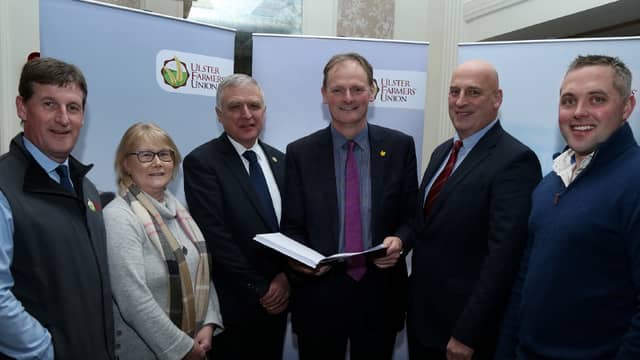
This issue of ammonia was one of many discussed at the annual event, which is delivered by the UFU Executive team consisting of president, David Brown and his deputies, William Irvine and John McLenaghan, and CEO, Wesley Aston.
Informative briefings around Bovine TB, the NI Protocol, future agricultural policy and climate change held the attention of the some 80 local farmers who had braved adverse weather conditions to attend, and, as is customary, the floor was then opened up to allow the farmers themselves to have their say.
President David Brown made no bones about the profound changes occurring in the agricultural sector, including climate change concerns, ammonia emissions and basic payments going forward.
He explained that while Single Farm Payments are continuing, the money is now being paid from Westminster as opposed to the EU (due to Brexit), and as this is essentially taxpayers money, the onus will soon be on farmers to demonstrate positive outcomes, particularly when it comes to climate change and the environment.
However, the president also argued that this will also present "opportunities" for farmers to make vital positive contributions to delivering positive environmental outcomes, and to be properly recognised by society for doing so.
Ammonia
Another huge challenge that farmers must rise to is that of ammonia emissions, according to UFU deputy president, William Irvine.
The Armagh dairy farmer said that DAERA had identified ways that every farmer can reduce their on-farm ammonia emissions, and that at least some of these measures will sooner or later have to be adopted.
Briefing the crowd on these measures, Mr Irvine said: "Changes to livestock housing could see an eight per cent reduction in emissions.
"There is also talk of adding additives to (livestock) meal, so that when cows burp they wont put out as many emissions, but we don't know what reduction this will achieve.
"There are also ambitions to encourage a longer grazing season, but how we will achieve this, we don't know. Farmers here tend to let their stock out when the ground it suitable and bring them in when it's tramped, so we will have to see how that one goes.
"The strategy is also encouraging the covering of existing above ground slurry stores, which could reduce ammonia by 1 per cent. How practical this will be on existing stores remains to be seen, but it is likely that all new stores will require a cover from day one."
Mr Irvine also explained how tree and hedge planting programmes around farms could see reductions of ammonia by 10 to 25 per cent, while other measures such as selective breeding programmes for livestock and crude protein in livestock diets could see emissions reduced.
Greenhouse gases
The deputy president also spoke to dispel often widespread confusion surrounding ammonia emissions with greenhouse gases/C02 emissions. He stressed that while greenhouse gases and climate change is a worldwide issue, ammonia is a separate issue and very much a Northern Ireland problem, and is a particular headache for farmers as they are responsible for 97 per cent of emissions.
"Ammonia is in a different category and it is a local NI issue," he said. "It is directly impacts our air quality and human health, and that is why it's a more difficult one for agriculture.
"Agriculture is producing 97 per cent of ammonia, it is in a different place and problem than greenhouse gases that cause climate change."
As such, Mr Irvine urged farmers to respond to the present consultation regarding NI's ammonia strategy, which was released this month, and cited the previous success of recent Bovine Tb policy that was hugely shaped by a large volume of consultation responses from Northern Ireland farmers.
Echoing Mr Irvine's points on ammonia emissions, president David Brown said farmers will need to think about adopting at least a number of the aforementioned measures to ensure ammonia targets are met.
"The issue here is that our livestock is producing too much ammonia," he said. "Without a doubt, every one of these measures has a cost linked to it and carry a very real cost.
"But if 30 per cent has to be found, farmers need to start picking out measures they can implement. This is a target that can encourage us as farmers to take the measures to ensure the future viability of our businesses."
Mr Brown added that high ammonia levels are already having an adverse impact on planning applications for farmers, and said this was another reason why it is in the interest of farmers to see levels reduced.
Badger cull
The all-important issue of Bovine Tb, and the prospect of a limited badger cull in an effort to reduce the prevalence of the disease, was also discussed at the roadshow.
UFU deputy president, John McLenaghan, said that while some are against a badger cull, it is something that the farming industry and the UFU has long been lobbying for.
The limited cull was approved by former agriculture minister, Edwin Poots, and while it has proved to be an emotive issue, many within the agricultural sector are supportive as wildlife, particularly badgers, are a significant factor in TB maintenance and spread in the environment.
Mr McLenaghan said that the earliest that the cull will start will be September of this year, and the area of the "first intervention" has yet to be determined by DAERA. He also called on farmers to stand behind the cull to ensure that it comes to fruition
said: "We need everyone in the industry to get behind this as it won't be easy because there are many opposed to it," he said. "It's vitally important that we all work together, as we have for the first time a great opportunity to tackle this, and that is something we don't want to miss out on."