

Beragh native Dr McAleer honoured with OBE for Services to Cancer Care
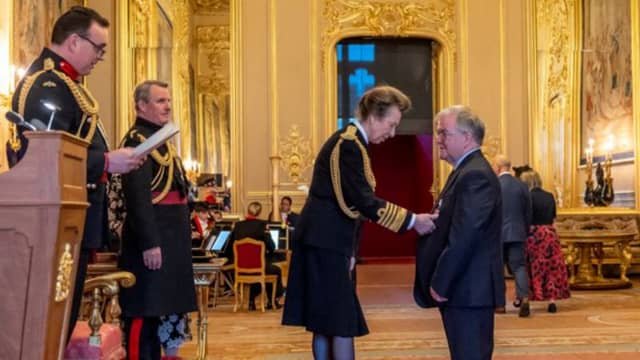

BERAGH native Dr Seamus McAleer, Consultant Clinical Oncologist at the Northern Ireland Cancer Centre and Clinical Senior Lecturer in Oncology at Queen's University Belfast, has been awarded an Officer of the Order of the British Empire (OBE) for his outstanding contributions to cancer care and treatment in Northern Ireland. The honour, presented at a special ceremony in Windsor last Wednesday, recognises Dr. McAleer’s transformative impact on oncology over a distinguished career spanning four decades.
BERAGH native Dr Seamus McAleer, Consultant Clinical Oncologist at the Northern Ireland Cancer Centre and Clinical Senior Lecturer in Oncology at Queen's University Belfast, has been awarded an Officer of the Order of the British Empire (OBE) for his outstanding contributions to cancer care and treatment in Northern Ireland.
The honour, presented at a special ceremony in Windsor last Wednesday, recognises Dr. McAleer’s transformative impact on oncology over a distinguished career spanning four decades.
A native of Curr Road, he was one of 11 children of parents James and Rita.
James ran a builder providers business and was also a part-time farmer.
He is married to Geraldine, (née Rainey) and the couple have three daughters, Catriona, Pauline and Claire.
He currently resides outside the village of Drumbo in Co Down.
Dr McAleer attended Roscavey Primary School and Omagh Christian Brothers before leaving in 1975 for Trinity College, Dublin and his journey in medicine was inspired by a desire to save lives. He qualified in 1981.
His career has been defined by his commitment to advancing cancer treatment but was initially inspired to look at a career in medicine thanks to reading books and watching television where the doctor seemed to make a difference and was saving lives.
"In the early 1980s when I had to make a career choice, I saw cancer treatments as being under-developed, toxic and not very effective,” he said.
“In contrast I felt cardiology and kidney disease treatment were well worked out and modernised. I therefore felt I had a big chance to contribute to cancer research. There were always lots of clinical trials available in this field so I felt I could make more progress working with that disease. I wanted the discipline that presented the most challenge and the most interest."
Dr McAteer worked in Altnagelvin Hospital in Derry for three years before moving to the Royal Victoria Hospital in Belfast and then to Belvoir Park Hospital from 1985.
The Cancer Centre moved to Belfast City Hospital in 2006 and he took charge as its clinical director from 2008 until 2014.
He has also been a consultant and a senior lecturer at Queen's University, Belfast since 1992.
As an oncologist, Dr McAleer specialised in many areas including melanoma, testicular and breast cancers.
He also did a Clinical Fellowship in the Royal Marsden Hospital in London at their Testicular Cancer Unit in 1989.
He ran Clinical Oncology education for the UK for three years in his role as Medical Director for Education and Training at the Royal College of Radiologists, also in London between 2014-2017.
Dr McAleer was also involved in the planning of the Cancer Centre at the City Hospital in Belfast in 2006 and was the lead clinician in developing the North West Cancer Centre at Altnagelvin which opened in 2016.
Passionate advocate
Outside his professional achievements, Dr McAleer has been a passionate advocate for cancer patients through his work with Friends of the Cancer Centre.
Over the years, his cycling adventures have included routes ranging from the Camino from France across the north of Spain to Santiago de Compostela in 2006, the 600-mile route between Seville in the south of Spain to the north of Spain, Mizen to Malin twice, the Soft Border Cycle as well as cycling the 600-mile route through the Appalachian Mountains in the United States in 2003.
His pedal power has raised over £250,000.
His interest in cycling developed while training in different hospitals and various parts of the university throughout Dublin. Training took place at several centres around the city.
"No one had a car in those days so the bicycle was the obvious way to get around. I then took my cycling adventures out to the Wicklow Mountains and once a term I would have cycled from Dublin to Beragh on a Friday and heading back again to Dublin on the Sunday which was approximately 100 miles each way," he said.
Now semi-retired, he works one day a week at the Cancer Centre and one at the university. He humbly credited his teams and colleagues for the honour. He says receiving the OBE was a surprise but credits all who worked with him over the years for playing an important part in it too.
‘Team effort’
“This recognition is not just for me; it’s for all those who have worked alongside me. Oncology has always been a team effort, and I am proud to have been part of such dedicated and talented groups.”
“When I got the letter telling me I got the award I checked carefully in case someone was taking a hand at me but once I established it was genuine, I replied and felt quite proud that people saw it worth their while to make a big effort to promote and put me forward for the award. Someone doesn't decide out of the blue to give it to you.
“To my mind, it's not an award for me, it's a reward for all those people who worked with me in various capacities I had an input but others made the argument, wrote up the cases - because you lead the team you get the credit but I see it as a reward for everyone who played a part.
“We achieved a lot in cancer. When I entered oncology we had about five consultants, now we have 60. The work has increased enormously and the survival rate has done the same.
“When I started in oncology in the mid-1980s, the ten-year cancer survival rate was just 25%. Today, it has surpassed 50%, and I believe future oncologists will achieve survival rates of 75% to 85%.
“The strides we’ve made in screening, specialised surgery, radiotherapy, and targeted therapies like immunotherapy are incredible achievements.
“People are now much more aware of the symptoms of cancer so earlier diagnosis and screening helps. There is now more dedicated surgery so surgeons are now specialists.
“It used to be surgeons operated on whatever came their way but now if you have bowel cancer you are operated on by a colorectal cancer specialist, if you have breast cancer it's a breast cancer specialist. When I started in oncology the same surgeon could well have done both these operations.
“Radiotherapy has become much more refined and much more effective and Chemotherapy and the new targeted therapy treatments are less toxic and much more effective. Immunotherapy uses the immune system to kill off cancers when they recognise the cancer cells as being foreign to the body which helps long-term survival rates.”
He added different treatments came through at different times and now different options for treating cancer are also making a big difference.
As he looks to the future, he remains optimistic, predicting continued advancements in treatment and survival rates.
“The future of oncology is bright. Our work in clinical trials, research, and innovation is setting the stage for even greater breakthroughs in the years to come.
“In 1996 I set up our first clinical trials unit at the Cancer Centre and we now put hundreds of people into trials every year. These compare old treatments to new ones and show us which ones are better. We are improving everything incrementally and over time this amounts to a big change. It leads to a growing workload in Oncology ad strains our budgets, as the new therapies are very expensive.
“I fully expect that the oncologists of the future will achieve survival rates of 75%-85%, and only the very frail or very elderly will die of cancer.”
Statistics
Dr McAleer points out current statistics tell us that one in two young people will get cancer in their lifetime.
“There are some toxins people take like tobacco and alcohol and they clearly cause cancer. Another factor is age as older people have much higher cancer rates. People who are overweight have a much higher risk of getting cancer than if those who are not.
“Generally people who are fitter get less cancer as well so it's the usual thing, a healthy life and a healthy diet reduce your risk of getting cancer and leads you in a position to fight it if you do get it, that's the general advice.”
He described the current state of provision of health services throughout Northern Ireland at the moment as a “conveyor belt of delays”.
“If people don't get to their GPs, they probably don't reveal all their symptoms over the phone and they're probably getting diagnosed later than they otherwise would do.
“If they need a scan there are delays and also they wait months rather than days or weeks for an urgent appointment with a consultant.
“The whole thing is going to be a conveyor belt of delays which is going to adversely affect the outcome of cancer and most other illnesses as many are time-dependent.
“The delays are disappointing. The funding isn't enough but not all the health care decisions such as building projects and plans in Northern Ireland were done for medical reasons, there was a lot of 'playing politics' done with services and hospitals. The funding is not enough but the funding was not always directed optimally”.
Looking local Dr McAleer said Omagh was better off now because it had a new diagnostic centre.
“People here will get more benefit out of that. They will be able to get their scans and heart assessments done and Northern Ireland needs more diagnostic centres.
“I have had an interesting career. I didn't expect to get an OBE, you don't plan for that but when it comes along I'm very grateful to have got it. In reality, I have been fortunate to be in medicine at a time that gave me a lot of opportunities to do things well. I've availed of opportunities that have taken me to a better place.
"Some may think Northern Ireland is a risk of being a 'backwater' so having representatives from Northern Ireland as I did running the oncology education or running the assessment programme for education - the exams that doctors do - that helps Northern Ireland produce better doctors. We are very lucky in that we have a cancer service that is well designed and essentially well run and that has meant our cancer services have done well accordingly. You are part of a bigger system and every person has to play their part for it to work. At the minute we are slipping a little bit in diagnosis because the services are not there to deliver it and that worries me for the future.”
Dr McAleer’s OBE not only honours his personal achievements but also shines a light on the transformative progress in cancer care driven by his dedication and innovation.